
The agentic intelligence layer between strategy and player behaviour.
De-risk every commercial decision. Quantify revenue, retention and margin impact before capital is committed.
of sportsbook bonus spend goes to players who'd have deposited anyway.
You see what they did. Not what they'll do next. Source: EGR Intel operator survey, 2026
Dashboards show last quarter. They can't tell you how the next bonus, regulation or vendor will land.
The exploitation, the churn and the adoption all live in the segments, not in the average.
Real reactions emerge from agents interacting, not from a spreadsheet of base rates.
Stop forecasting. Start interrogating your players.
A digital player society, not another dashboard.
A scenario goes in. Autonomous agents play it out. You can question any one of them.
- 01Seed
Define the question
Input the scenario: bonus, regulation, CRM move, product change, vendor decision or market event.
- 02Populate
Spin up the player swarm
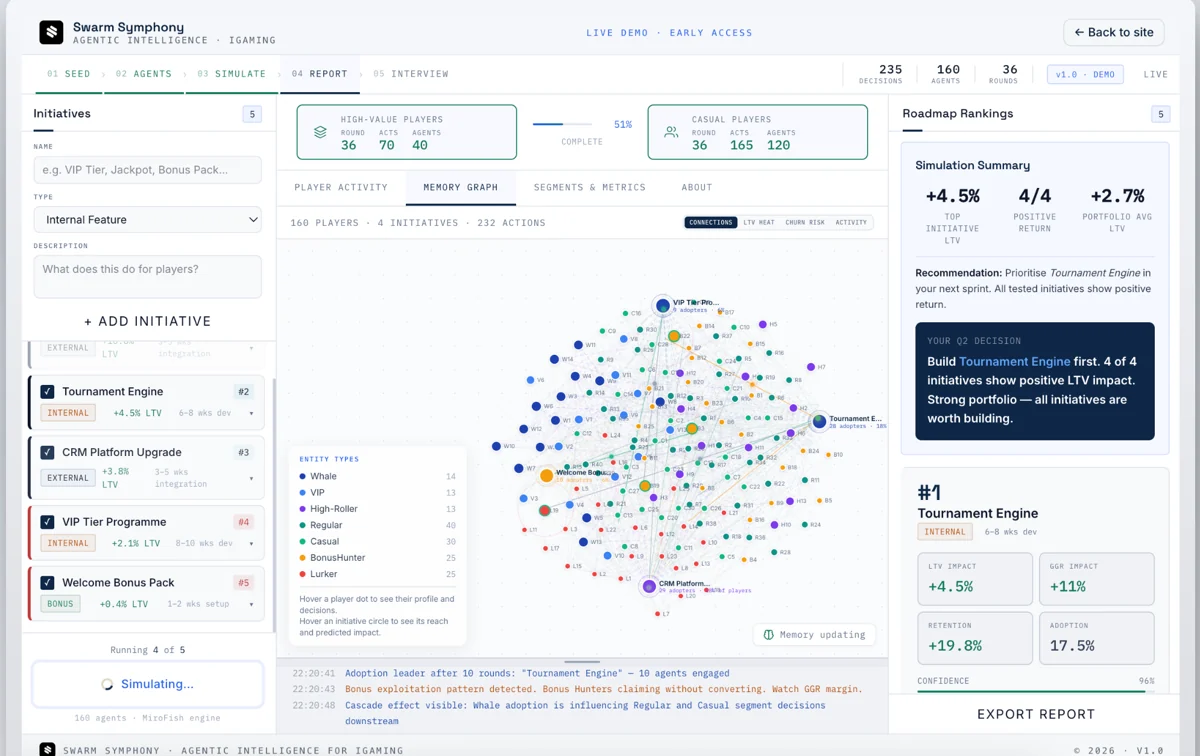
Autonomous player agents across Whales, VIPs, Regulars, Casuals, Bonus Hunters and Lurkers. Each carries memory, personality, value profile, churn risk, offer sensitivity and influence patterns.
- 03Simulate
Release into a live society
Agents react, influence each other, adopt, ignore, exploit or churn over time. Cascades emerge from the bottom up.
- 04Rank
See predicted impact
The engine ranks outcomes by LTV, GGR, retention, margin pressure and segment response, with confidence.
- 05Interrogate
Ask why. Change a variable. Re-run.
Open any agent or segment, test a new assumption, rerun the simulation in real time. The simulation is interrogable, not a static deliverable.
Six decisions. One swarm. Every reaction modelled.
Drop a stimulus into the simulation. Watch your player base react in real time.
Will this welcome offer attract value or attract abuse?
Watch Bonus Hunters coordinate, Casuals adopt and Whales ignore. See margin compression before the campaign goes live.
Tighten wagering to 40× or cap free spins → +9.2% net GGR.
How will players react to a £500 monthly deposit cap?
Simulate friction across segments. See where churn spikes, where loyalty holds, and how revenue redistributes.
Soft-cap with VIP review path retains 62% of lost Whale GGR.
Which win-back sequence actually retains your VIPs?
Run rival CRM journeys against the same swarm. Compare retention, win-back rate and segment cannibalisation.
Day-7 push alone captures 71% of the lift at 1/3 the cost.
Will a new live-casino vertical pull players or split attention?
See cross-product cannibalisation, who migrates, who sticks, and net GGR effect by segment.
Whales drive 64% of net lift; gate the cross-sell to mid-value+.
Does this provider's content actually move your player base?
Vendor benchmarks come from someone else's swarm. Test their pitch against yours.
Vendor claim overstated 4×. Negotiate revshare on actual lift.
Competitor launches a 200% welcome bonus. What breaks?
Inject the shock and watch the cascade: who leaves, who stays, what the recovery curve looks like.
Defensive £50 reload to top 2 deciles recovers 78% of deposits.
Tap a card to flip
Every decision, simulated before it ships.
A commercial read on behaviour, before you act.
Segment by segment. Risk by risk. Rerun in real time.
Adoption, churn and exploitation by Whale, VIP, Regular, Casual, Bonus Hunter and Lurker, per market.
Bonus abuse exposure, margin compression, regulatory friction and churn pressure surfaced before launch.
Run rival versions of the same decision against the same swarm. Compare LTV, GGR and retention side by side.
Seven archetypes. One living, talking player base.
Modelled from your operator profile. Agents react to the scenario and to each other.
Whale
Biggest revenue drivers. Adoption cascades to other segments.